USPTOSearch export
Information disclosure statement
IDS37 CFR 1.97 and 1.98
The applicant's own list of prior art for the examiner of a pending US application. It is how the duty of candour in 37 CFR 1.56 is met, and every item the examiner considers is printed on the patent.
At a glance
- Deadline
- Until the issue fee is paid
- Official fee
- $0 - $1,080
- Proceeding
- Applicant's own · ex parte
- Agent needed
- Yes, if a company
- Owner faces
- Its own filing
- Who files
- The applicant, on behalf of everyone with a duty of disclosure: the inventors, the attorney or agent, and others substantively involved (37 CFR 1.56(c)). Not a third party.
- Deadline
- Any time before the issue fee is paid. Free within 3 months of filing or before the first action on the merits; later it needs a fee or a 1.97(e) statement.
- Language
- English. A non-English item needs a concise explanation of its relevance, plus any translation the applicant already holds (37 CFR 1.98(a)(3)).
- Anonymous
- Not applicable. The IDS is the applicant's own paper in its own application.
- Representation
- A company applicant must act through a registered patent practitioner (37 CFR 1.31). An individual inventor may sign and file it.
- How it is filed
- Patent Center, with the citations on PTO/SB/08 or an equivalent list, and copies of the foreign and non-patent documents uploaded with it.
- Effect
- The examiner considers each compliant item and initials it on the list. Considered items are printed on the patent as references cited.
- Party status
- The applicant's own ex parte prosecution. No third party takes part.
Official fee, in detail
| When | Fee |
|---|---|
| Within 3 months of filing, or before the first action on the merits | $0 |
| After that, before a final action or allowance | $280 (small entity $112, micro $56), or a 1.97(e) statement instead |
| After a final action or allowance, before the issue fee is paid | $280 and a 1.97(e) statement |
| Size fee, once the application passes 50, 100 or 200 cited items | $200, $500 or $800, less size fees already paid |
An early, short IDS costs nothing. The most one IDS can cost is $1,080: a late one, at the large-entity rate, that takes the count past 200 items. The size fee has no small-entity rate. Office fees only, checked 13 October 2026.
 8 pages · PDF
A real one, as filed
Information disclosure statement, with transmittal letter
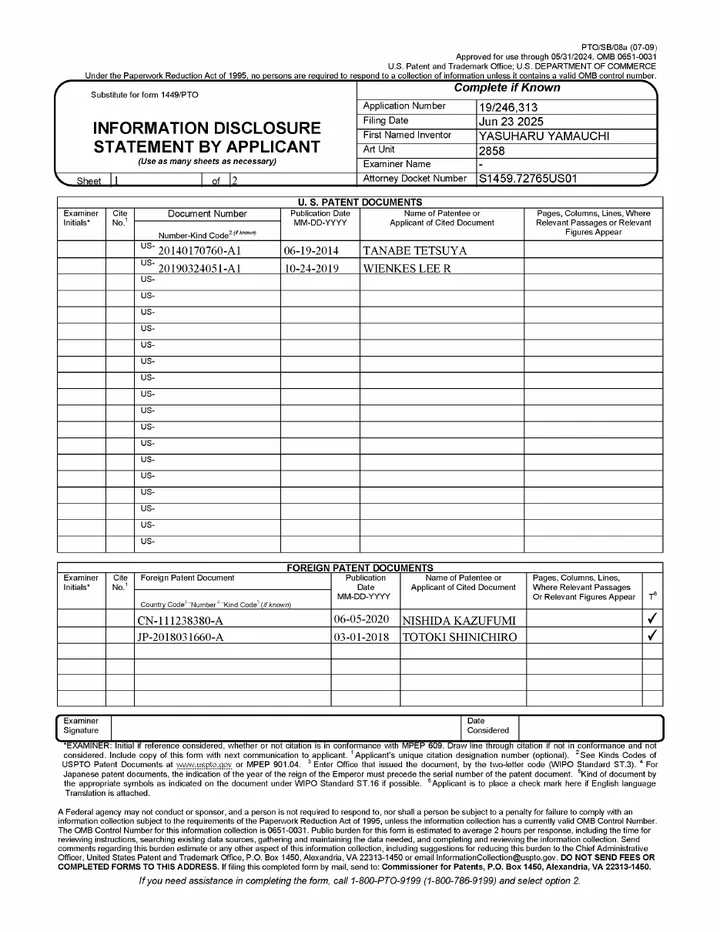
Sony's IDS in its own application: two US publications, two foreign documents and one article, listed on form PTO/SB/08.
What it is
Information disclosure statement, in brief
Everyone substantively involved in filing and prosecuting a US application owes the Office a duty of candour: information they know to be material to patentability must be disclosed (37 CFR 1.56). The information disclosure statement is the standard way to do it. It lists each patent, published application and other document on form PTO/SB/08, with a legible copy of every foreign patent document and non-patent item, and a concise explanation of anything not in English (37 CFR 1.98).
The examiner initials each item considered and returns the list. Considered items are printed on the patent as references cited, so the closest art is on the record before anyone litigates the patent. Material art that was known and withheld can make the whole patent unenforceable for inequitable conduct.
Timing sets the price. Filed within three months of the filing date, or before the first Office action on the merits, an IDS is free. Later it needs a fee or a statement that the art was first cited in a counterpart application within the last three months, and once the issue fee is paid it is considered only if the application is withdrawn from issue.
Use it when
- You are the applicant, or its attorney or agent, and know of art material to patentability, including art cited against a counterpart application abroad.
- A search has turned up references the examiner should see before the claims are allowed.
- You want the closest art considered and printed on the patent, so that it cannot later be called art the Office never saw.
Choose another route when
- You are a third party with art against someone else's pending application: an IDS is not yours to file. Third-party preissuance submission
- The patent has already issued and you want art placed in its file. Citation of prior art in a patent file
How IPtorch prepares it
From search to citation listing.
The references a prior-art search keeps are already the list an IDS needs. The report exports them in the form's own layout, so nothing is retyped.
- 1SearchClaims split into limitations, candidates screened, the closest references read in full.Every hit checkable
- 2ReportThe references you keep, each with number, kind code, date and patentee.Your selection
- 3ExportIDS (SB/08a) from the report: three tables, one running cite number.One PDF
- 4You fileAttach it to the signed form with copies of foreign and non-patent documents.Nothing is filed
What the export does
- Every reference kept in the search report is listed with its number, kind code, publication date and patentee or applicant.
- US grants, US application publications and foreign documents go into the form's three tables, numbered in one running sequence.
- Foreign documents keep their country and kind codes in separate columns, beside the T column for translations.
- A reference whose number cannot be read is named at the foot of the listing, to add by hand.
In the download
- IDS citation listing (PDF)US patents, US application publications and foreign patent documents, each in its SB/08a table with a cite number
- Matter headerApplication, applicant, docket number and the count of documents cited
- Columns left for youExaminer initials, relevant pages and the translation mark, completed on the filed form
What stays with you
You review, sign and file.
- Complete and sign form PTO/SB/08a: application number, filing date, first named inventor, art unit, examiner and docket number.
- Upload a copy of each foreign patent document and non-patent item, and a concise explanation for anything not in English.
- Check the timing: add the 1.97(e) statement or the fee once the free window has closed, and count the cumulative items for the size fee.
Where these go wrong
What to check before filing.
- An IDS filed after the first action without the fee or a 1.97(e) statement goes in the file but is not considered.
- A foreign or non-patent document listed without a legible copy is crossed out by the examiner, not considered.
- The IDS that takes the application past 50, 100 or 200 cumulative items carries a size fee of $200, $500 or $800.
Start with the evidence.
Upload the application or enter its number. The search finds the art to cite, and the report exports the IDS listing.
Start a prior-art searchFacts checked against the office's rules on 22 September 2026, fees on 13 October 2026. The sample is a public record, reproduced unchanged. IPtorch is not a law firm and this page is not legal advice. Its output is unsigned work product for a registered professional to review, sign and file; nothing is filed and no fee is paid for you. Confirm current requirements, fees and deadlines with the receiving office.