PTABEvidence from your search
Derivation proceeding
DER35 U.S.C. 135; 37 CFR 42.400 to 42.412
A trial at the Patent Trial and Appeal Board on one question: did an inventor named in someone else's earlier application take the claimed invention from your inventor and file for it without authorization. If so, the Board corrects the inventors and the claims fall.
At a glance
- Deadline
- 1 year from the rival claim
- Official fee
- $452
- Proceeding
- Inter partes trial · named
- Agent needed
- No
- Owner faces
- Inventorship trial at PTAB
- Who can file
- An applicant for a US patent whose own application claims the same or substantially the same invention as another party's earlier application or patent (35 U.S.C. 135(a); 37 CFR 42.402). A patent owner can petition only by filing a reissue application; otherwise a dispute between two patents goes to federal court under 35 U.S.C. 291.
- Deadline
- Within the one-year period after the respondent's claim to the same or substantially the same invention was first published in an application publication or granted in a patent, whichever is earlier (35 U.S.C. 135(a)(2)). The clock runs from the respondent's publication, not from the petitioner's own filing or publication.
- Language
- English. Any document relied on in another language must be filed with an English translation and an affidavit attesting to its accuracy (37 CFR 42.63(b)).
- Anonymous
- No. The petition must name every real party in interest and identify the petitioner's own application, and it is served on the respondent (37 CFR 42.8(b)(1), 42.405, 42.406).
- Representation
- Not required. A party that uses counsel must name a lead counsel who is a registered patent attorney or agent and at least one back-up counsel; other lawyers can appear pro hac vice (37 CFR 42.10).
- How it is filed
- Electronically in the PTAB's P-TACTS system as a "DER - Derivation Proceeding" petition, with the fee, at least one supporting affidavit and service on the respondent's correspondence address of record. No filing date is given until the petition is complete, paid and served (37 CFR 42.404 to 42.407).
- Effect
- If derivation is proved, the Board can correct the inventors named in the application or patent at issue. Claims the Board rules against are finally refused in an application, or cancelled in a patent once no appeal remains (35 U.S.C. 135(b), (d)).
- Party status
- The petitioner and the respondent are both full parties to a trial heard by a panel of at least three PTAB judges. Either can appeal the final decision to the Federal Circuit or bring a district court civil action within 63 days; if one side appeals, the other can elect to move the case to district court (35 U.S.C. 6(c), 141(d), 146; 37 CFR 90.3).
Official fee, in detail
| When | Fee |
|---|---|
| Filing the petition | $452 (37 CFR 42.15(c)(1)), same for large, small and micro entities |
| After institution | No further USPTO fee |
| Lawyer who is not a registered practitioner, appearing pro hac vice | $269 (37 CFR 42.15(e)) |
| Request to see a settlement agreement kept confidential | $452 (37 CFR 42.15(d)) |
The $452 petition fee is the only USPTO fee needed to start and run a derivation trial, and it has no small or micro entity reduction. Unlike inter partes and post-grant review there is no post-institution fee, and no filing date is given until the fee is paid (37 CFR 42.404(b)). Office fees only, checked 13 October 2026.
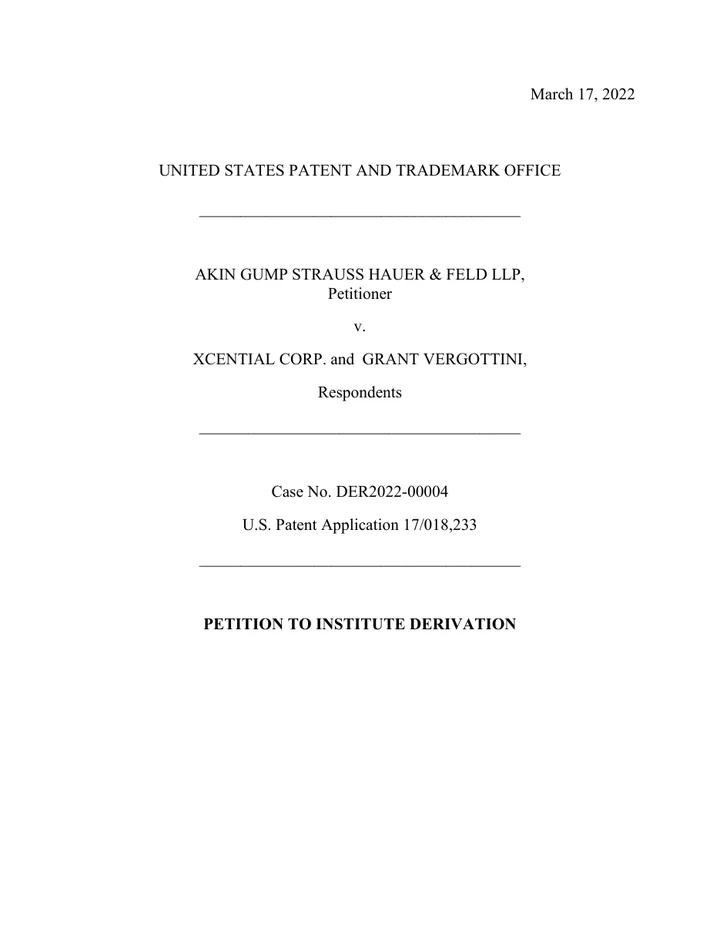 74 pages · PDF
A real one, as filed
Petition to institute a derivation proceeding
Akin Gump argued that an inventor of Xcential's earlier application took the invention from Akin Gump's inventors. The Board denied institution on 28 November 2023.
What it is
Derivation proceeding, in brief
A derivation proceeding is a trial at the Patent Trial and Appeal Board that answers one question: did an inventor named in someone else's earlier application take the claimed invention from an inventor named in yours, and file for it without authorization. Under the first-inventor-to-file system the earlier filer normally wins, so this is the remedy against a party who filed first on an invention it got from you. It took effect on March 16, 2013 and is open to applicants under that system.
The petition must show, with substantial evidence and at least one affidavit, that your inventor conceived the invention and communicated it to the respondent, that the communication is corroborated, and that the filing was not authorized (37 CFR 42.405). The Board usually holds the petition until the claims involved are otherwise ready for allowance, then decides whether to institute; that decision is final and not appealable. Once instituted, the Board aims for a final decision within one year. The parties can end the case by agreeing on the correct inventor, or by binding arbitration (35 U.S.C. 135(e), (f)).
Use it when
- You disclosed an invention to a partner, customer, supplier or former employee, and they filed a US application on it before you did without your permission.
- Their claim first published or issued less than a year ago, and your own US application claims the same or substantially the same invention.
- You can prove conception and communication with dated records, such as emails, NDAs, meeting notes or drawings, and a witness who will sign an affidavit.
Choose another route when
- You want the other side's patent cancelled because the invention was not new or was obvious, not because it was taken from you. Inter partes review petition
- The patent issued less than nine months ago and you want it cancelled on any validity ground rather than its inventors corrected. Post-grant review petition
- The other application has not been published yet and you only want the examiner to see prior art. Protest by a member of the public
- You are threatened with an infringement suit on the patent and need a court ruling now. Declaratory judgment complaint
- Both sides already hold issued patents and you will not file a reissue application: sue under 35 U.S.C. 291 within one year of the first patent's issue.
Where IPtorch fits
The publication record around the disputed claims.
A derivation case is won on dated records of conception and communication from your own files. IPtorch's search shows what was public, and when, around the claims in dispute.
- The respondent's claims split into limitations, with the earliest publications that disclose each one and their dates.
- A check that the invention was not already public before either side filed, which would settle the dispute on prior art.
- Prior art for an inter partes or post-grant review of the same patent, if derivation is hard to prove.
Where these go wrong
What to check before filing.
- The one-year clock starts when the respondent's claim is first published or granted, and you need your own US application with a matching claim on file before you petition. In the sample case the petitioner filed its application one day before the petition, and the petition one day before the deadline.
- Showing you were first is not enough. The petition must prove your inventor conceived the invention and communicated it to the respondent's inventor before they filed, with corroboration beyond your inventor's own word. Of the 28 derivation cases in the USPTO's public PTAB data, only 2 reached trial.
- Expect a long wait: the respondent files no preliminary response, but the Board can defer the petition until three months after the respondent's patent issues and usually waits until the claims involved are otherwise ready for allowance. The sample petition waited 20 months for a denial.
Start with the evidence.
Upload the patent or enter its number. The invalidity search charts every claim.
Start an invalidity searchFacts checked against the office's rules on 22 September 2026, fees on 13 October 2026. The sample is a public record, reproduced unchanged. IPtorch is not a law firm and this page is not legal advice. Its output is unsigned work product for a registered professional to review, sign and file; nothing is filed and no fee is paid for you. Confirm current requirements, fees and deadlines with the receiving office.