German courtsEvidence from your search
Negative declaratory action
Section 256(1) ZPO; Section 143 PatGNegative Feststellungsklage
A civil action in which an accused company asks a German regional court to declare that it does not infringe a patent or utility model. It answers a warning letter on your timing; patent cases go only to the patent chambers of twelve regional courts, and a lawyer must conduct them.
At a glance
- Deadline
- Once you are accused
- Official fee
- €7k - €31k, by value
- Proceeding
- Court action · named
- Agent needed
- Yes
- Owner faces
- Suit to clear the product
- Who can file
- Anyone with a legal interest in a prompt declaration (Section 256(1) ZPO), typically a company that has received a warning letter or has otherwise been accused of infringing a German patent, the German part of a European patent, or a utility model.
- Deadline
- No statutory deadline. The interest lapses once the owner sues for infringement on the same matter and can no longer withdraw that suit on its own (BGH X ZR 17/03 with Section 269(1) ZPO), unless the declaratory case is already ripe for decision.
- Language
- German (Section 184 GVG). The English-language Commercial Chambers open since 2025 (Section 184a GVG) cannot take patent or utility model cases, because Section 119b(1) GVG excludes industrial property disputes.
- Anonymous
- No. The complaint must name both parties (Section 253(2) ZPO). Published judgments are anonymised, but the owner and the court know who is suing.
- Representation
- Mandatory: a Rechtsanwalt must file and conduct the case before the Landgericht (Sections 78(1) and 130d ZPO). A patent attorney usually assists, and the losing side reimburses that attorney's statutory fees (Section 143(3) PatG, Section 27(3) GebrMG).
- How it is filed
- A written complaint to the patent chamber of one of the twelve designated Landgerichte (Berlin II, Braunschweig, Düsseldorf, Erfurt, Frankfurt am Main, Hamburg, Leipzig, Magdeburg, Mannheim, Munich I, Nuremberg-Fürth, Saarbrücken), which have exclusive jurisdiction (Section 143 PatG, Section 27 GebrMG). Utility model cases from Rhineland-Palatinate go to Frankenthal.
- Effect
- A final judgment settles between the two parties whether the product or process infringes. It does not revoke a patent, which takes an opposition at the DPMA or a nullity action at the Federal Patent Court (Sections 59 and 81 PatG).
- Party status
- The accused company is the claimant and the owner the defendant. The owner usually counterclaims for infringement, and the declaratory claim is then declared settled as far as the counterclaim covers it.
Official fee, in detail
| When | Fee |
|---|---|
| Value in dispute €250,000 (3.0 x €2,458) | €7,374 |
| Value in dispute €500,000 (3.0 x €4,138) | €12,414 |
| Value in dispute €1,000,000 (3.0 x €6,238) | €18,714 |
| Value in dispute €2,000,000 (3.0 x €10,438) | €31,314 |
| Value in dispute €5,000,000 (3.0 x €23,038) | €69,114 |
First-instance court fee of 3.0 times the Section 34 GKG fee (cost schedule no. 1210), payable before the complaint is served (Section 12(1) GKG), on a value the court sets at its discretion (Section 51(1) GKG). Lawyers' and patent attorneys' fees come on top and the loser pays both sides', but a party whose finances would be seriously endangered can apply before the hearing for costs on a reduced value (Section 144 PatG, Section 26 GebrMG). Office fees only, checked 13 October 2026.
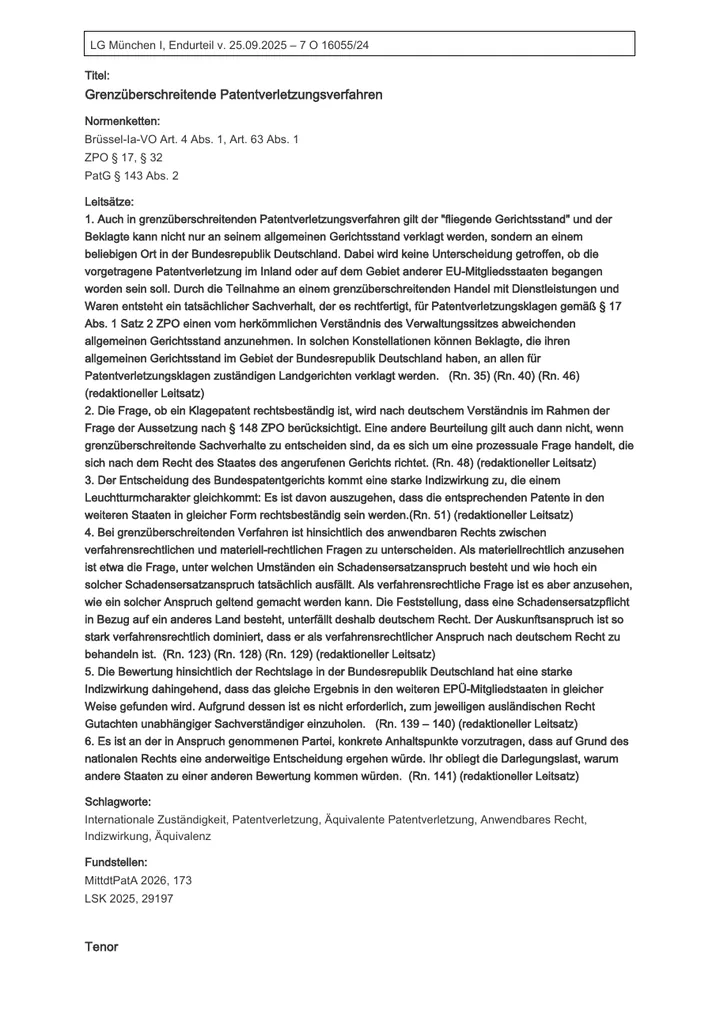 45 pages · PDF
A real case, as decided
Judgment on a negative declaratory action and the infringement counterclaim
Biosimilar makers asked for a declaration that their aflibercept product does not infringe a Regeneron patent. The Munich court dismissed the action, found infringement by equivalent means and largely upheld the counterclaim.
What it is
Negative declaratory action, in brief
A civil action in which a company asks a German court to declare that it does not infringe a patent or utility model (Section 256(1) ZPO). It is the answer to a warning letter: instead of waiting to be sued, the accused party takes the dispute to court on its own timing. Patent and utility model cases go exclusively to the patent chambers of twelve designated regional courts (Landgerichte), and the parties must be represented by lawyers.
The claimant needs a legal interest in a prompt declaration, which a warning letter or other claim of rights normally provides. That interest does not survive an infringement suit: once the owner sues on the same matter and can no longer withdraw unilaterally, the declaratory action becomes inadmissible and is usually declared settled, and the dispute continues as an infringement case. The court decides infringement only; a patent's validity is attacked separately, at the DPMA or the Federal Patent Court.
Use it when
- You have received a warning letter you consider unfounded and need certainty before you launch or keep selling a product.
- The owner tells customers or distributors that you infringe but does not sue.
- You want to set the timing and pick the forum yourself instead of waiting for the owner to do so.
Choose another route when
- You think the German patent is invalid and it was granted less than nine months ago: file an opposition at the DPMA. Opposition
- You think the German patent is invalid and the opposition period is over: bring a nullity action at the Federal Patent Court. Nullity action
- The right is a utility model you consider invalid and you want it removed for everyone: file a cancellation request at the DPMA. Utility-model cancellation
- The patent is a European patent in the UPC system and you want one ruling for all UPC states. Declaration of non-infringement
- The owner has already sued you for infringement on the same matter and can no longer withdraw: defend that action instead.
- The patent is a US patent. Declaratory judgment complaint
Where IPtorch fits
The invalidity case to run beside it.
The court rules on infringement only. Most accused companies also attack the patent, at the DPMA or the Federal Patent Court, and IPtorch builds that case; your lawyer drafts the declaratory complaint.
- Every claim split into limitations and charted against the closest prior art, with the quoted passage behind each cell.
- The builder drafts the parallel opposition or nullity action, unsigned and in German.
- The same evidence supports a request to stay the owner's infringement counterclaim while the nullity action runs (Section 148 ZPO).
Where these go wrong
What to check before filing.
- The race to court: once the owner's infringement suit can no longer be withdrawn without your consent, which happens when you begin arguing the merits at the oral hearing (Section 269(1) ZPO), your action loses its legal interest and is dismissed as inadmissible unless you declare it settled (BGH X ZR 17/03).
- The court rules on infringement only. If you also think the patent is invalid, start an opposition or nullity action in parallel (Sections 59 and 81 PatG); the declaratory judgment will not remove the patent.
- A claimant without its usual residence in the EU or EEA must give security for the owner's costs if asked (Section 110 ZPO), and the complaint is not served until the court fee is paid (Section 12(1) GKG).
Start with the evidence.
Upload the patent or enter its number. The invalidity search charts every claim.
Start an invalidity searchFacts checked against the office's rules on 22 September 2026, fees on 13 October 2026. The decision is a public record, reproduced unchanged. IPtorch is not a law firm and this page is not legal advice. Its output is unsigned work product for a registered professional to review, sign and file; nothing is filed and no fee is paid for you. Confirm current requirements, fees and deadlines with the receiving office.