UPCEvidence from your search
Declaration of non-infringement
DNIArt. 32(1)(b) UPCA; Rules 61 to 77 RoP
An action at the Unified Patent Court for a ruling that a specific act, such as making or selling a product, does not infringe a European patent. You choose the moment instead of waiting to be sued, and one judgment covers every UPC state where the patent has effect.
At a glance
- Deadline
- Any time; ask the owner first
- Official fee
- €14,600 + by value
- Proceeding
- Court action · named
- Agent needed
- Yes
- Owner faces
- Lawsuit, defence in 2 months
- Who can file
- Any person doing, or proposing to do, a specific act, against the patent proprietor or a licensee entitled to sue for infringement under Art. 47 UPCA (Rule 61.1 and 61.2 RoP). If the owner has not accused that act of infringement, the claimant must first ask in writing for an acknowledgment of non-infringement with full particulars of the act, and may sue only if the owner refused or did not answer within one month (Rule 61.1(a) and (b)).
- Deadline
- No time limit while the patent is in force and not opted out. The Defence is due two months after service of the Statement (Rule 67), the Reply within one month and the Rejoinder one month after the Reply (Rule 69).
- Language
- Before the central division, the language in which the patent was granted (Art. 49(6) UPCA; Rule 64 with Rule 45 RoP). If the parties agree on a local or regional division (Art. 33(7) UPCA), a language of that division under Rule 14.
- Anonymous
- No. The claimant is a named party, and the Statement must give the particulars of Rule 13.1(a) to (h) RoP and show that the Rule 61 conditions are met (Rule 63(a)).
- Representation
- Mandatory: a lawyer authorised to practise before a court of a Contracting Member State, or a European Patent Attorney with an appropriate qualification such as the European Patent Litigation Certificate (Art. 48(1) and (2) UPCA; Rule 8.1 RoP).
- How it is filed
- The representative lodges a signed Statement for a declaration of non-infringement electronically in the UPC Case Management System, using the official online forms (Rule 4.1 RoP), at the central division (Art. 33(4) UPCA). If the owner has already sued the same party on the same patent in a local or regional division, the DNI may only be brought there.
- Effect
- The Court declares that the specified act does not, or the proposed act would not, infringe the patent, binding the parties for every UPC state where the European patent has effect (Rule 61.1 RoP; Art. 34 UPCA). The patent stays in force; to remove it, a revocation action can be lodged together with the DNI (Rule 77).
- Party status
- Full adversarial court action: the claimant and the proprietor or licensee are parties, with written, interim and oral procedures and appeal to the Court of Appeal. If the owner sues for infringement in a local or regional division within three months of the DNI, the DNI is stayed (Art. 33(6) UPCA; Rule 76.3 RoP).
Official fee, in detail
| When | Fee |
|---|---|
| Fixed fee for the action (Rule 70 RoP) | €14,600 |
| Value of the action up to and including €500,000 | No value-based fee |
| Value up to and including €1,000,000 | + €5,300 |
| Value up to and including €2,000,000 | + €17,200 |
| Value up to and including €5,000,000 | + €42,400 |
| Value up to and including €10,000,000 | + €86,100 |
| Value up to and including €50,000,000 | + €331,000 |
| Value more than €50,000,000 | + €430,300 |
| Small or micro enterprise (Rule 370.8 RoP) | 50% of the fixed and value-based fee |
| DNI lodged together with a revocation action (Rule 77 RoP) | + €26,500 revocation fee |
Table of Court Fees as amended on 4 November 2025, applying to actions filed from 1 January 2026. The fixed fee is paid on filing; the judge-rapporteur sets the value during the interim procedure (Rule 74.1 RoP) and the value-based fee is due only if it exceeds €500,000. A small or micro enterprise must affirm its status in the Statement to pay 50%. Office fees only, checked 13 October 2026.
 10 pages · PDF
A real case, as decided
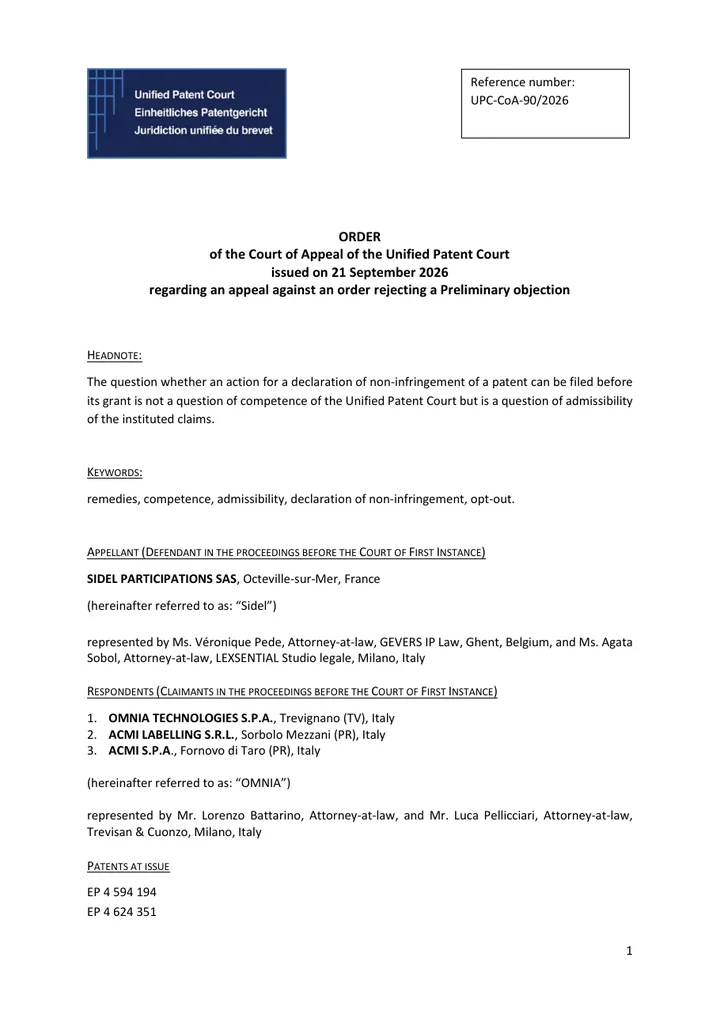
Court of Appeal order in the DNI action Omnia v Sidel
Omnia and ACMI asked for a declaration that their labelling module does not infringe two Sidel patents. On 21 September 2026 the Court of Appeal confirmed that the UPC hears the action, despite opt-outs filed after it was lodged.
What it is
Declaration of non-infringement, in brief
An action for a declaration of non-infringement asks the Unified Patent Court to rule that a specific act, such as making or selling a product, does not infringe a European patent, or that a planned act would not. It is the mirror image of an infringement action: the would-be infringer chooses the moment and goes first, instead of waiting to be sued.
It is brought at the central division, unless the owner has already sued the same party on the same patent in a local or regional division, and a single judgment covers every UPC state where the patent has effect. If the owner has not accused the act, the claimant must first ask in writing for an acknowledgment of non-infringement and wait a month. The patent itself is not touched; a revocation action can be joined to attack its validity.
Use it when
- You are about to launch a product in UPC countries and want a court ruling that it is clear of a specific European patent.
- The patent owner has sent a warning letter or asserted infringement and you want to pick the timing and the central division rather than wait to be sued.
- You want one decision covering all UPC states where the patent has effect instead of separate national declarations.
Choose another route when
- You want the patent cancelled, not only a ruling that your product is clear of it. Revocation action
- The European patent was granted less than nine months ago and you want it revoked at the lowest cost. Notice of opposition
- The patent is opted out of the UPC: seek the declaration from a national court, such as a German regional court. Negative declaratory action
- The dispute is about a US patent. Declaratory judgment complaint
- You expect an urgent injunction rather than a full action, and want the judge to hear you first. Protective letter
Where IPtorch fits
The prior art for the revocation action beside it.
A DNI is often lodged together with a revocation action (Rule 77 RoP). IPtorch's invalidity search builds the validity case; your representative drafts both pleadings.
- Every claim split into its limitations and charted against the closest prior art, with the quoted passage and its location behind each cell.
- At least 50 references read in full and ranked, the strongest first, ready for a revocation action or a counterclaim.
- When you lodge a revocation action with the DNI, the builder drafts that statement for revocation, unsigned.
Where these go wrong
What to check before filing.
- If the owner has not accused you, skipping the written request for acknowledgment with full particulars of the act, or suing before the one-month period runs out, exposes the action to dismissal (Rule 61.1 RoP).
- An infringement action by the owner in a local or regional division within three months of your filing stays the DNI (Art. 33(6) UPCA, Rule 76.3 RoP), and a DNI on a patent the owner has already asserted against you in a local division can only be brought in that division (Art. 33(4)).
- The value-based fee depends on the value the judge-rapporteur fixes, not on your own estimate (Rule 74.1 RoP), so a low valuation does not cap the bill.
Start with the evidence.
Upload the patent or enter its number. The invalidity search charts every claim.
Start an invalidity searchFacts checked against the office's rules on 22 September 2026, fees on 13 October 2026. The decision is a public record, reproduced unchanged. IPtorch is not a law firm and this page is not legal advice. Its output is unsigned work product for a registered professional to review, sign and file; nothing is filed and no fee is paid for you. Confirm current requirements, fees and deadlines with the receiving office.