WIPOObservations & Oppositions builder
PCT third-party observations
TPOPCT Administrative Instructions, Sections 801 to 805
A short, structured prior-art submission to WIPO against a published international application: up to ten documents, each with a brief explanation of why it defeats novelty or inventive step. It is published on PATENTSCOPE and reaches every designated office before the national phase.
At a glance
- Deadline
- Until 28 months from priority
- Official fee
- Free
- Proceeding
- No party status · anonymous allowed
- Agent needed
- No
- Owner faces
- No duty to respond
- Who can file
- Any third party with a free standard WIPO account. The applicant and its representatives cannot use it; they have their own ePCT action for close prior art.
- Deadline
- From the date of international publication until 28 months from the priority date, while the application is not withdrawn or considered withdrawn (Section 802(a)(ii)).
- Language
- Any of the ten PCT languages of publication (Arabic, Chinese, English, French, German, Japanese, Korean, Portuguese, Russian, Spanish); copies of the cited documents may be in any language.
- Anonymous
- Yes. You sign in to identify yourself to the International Bureau, but if you ask to stay anonymous it reveals none of your details to the public, the applicant, the authorities or the designated Offices (Section 803(b)).
- Representation
- Not required. Anyone may file in their own name or on behalf of a company or client, and the published form shows both fields.
- How it is filed
- Online only, through the ePCT third party observation service (signing in without strong authentication), reached directly or from the application's page in PATENTSCOPE. Paper or emailed submissions are not treated as observations.
- Effect
- The International Bureau checks only that it concerns novelty or inventive step and publishes it on PATENTSCOPE. It goes to the ISA, the supplementary ISA and the IPEA if their reports are not yet out, and to every designated Office after 30 months, which need not take it into account.
- Party status
- None. The observer gets no right to be heard or to intervene in the international phase, and the observation cannot be withdrawn or changed once submitted.
Official fee, in detail
| When | Fee |
|---|---|
| Observation filed in ePCT, between publication and 28 months from priority | No fee |
| Uploading copies of cited documents (up to 3 PDFs of 20 MB per citation) | No fee |
WIPO charges nothing for the third party observation service. The only cost is preparing the citations and explanations. Office fees only, checked 13 October 2026.
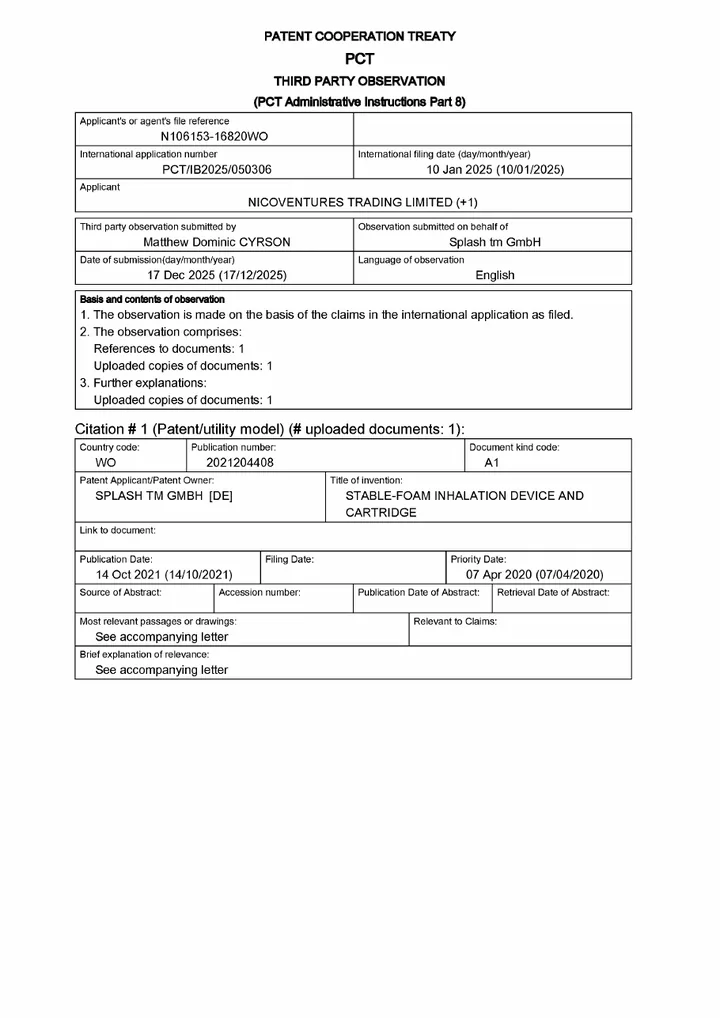 1 page · PDF
A real one, as filed
Third-party observation on PCT/IB2025/050306
Splash cited its own earlier application against a Nicoventures pouch application. WIPO accepted the observation and published it on PATENTSCOPE.
What it is
PCT third-party observations, in brief
A third party observation is a short, structured prior art submission made to the International Bureau of WIPO against a published PCT application. It lists between one and ten documents published before the international filing date (or patent documents with an earlier priority date), each with a brief explanation of up to 5,000 characters of how it destroys novelty or inventive step, and preferably a copy of each document.
The International Bureau checks only that the observation is about novelty or inventive step, then publishes it on PATENTSCOPE next to the search report. The uploaded copies stay private. The observation is sent to the searching and examining authorities if their reports are still pending, and to every designated Office after 30 months, so one free filing reaches all the national and regional offices before national phase examination starts.
Grounds it can carry
- NoveltyArt. 33(2) PCT
- Inventive stepArt. 33(3) PCT
Use it when
- A competitor's PCT application is published and you know prior art the international search missed, and you want every national office to see it before the national phase.
- You want to stay anonymous and pay nothing, and a written record of the prior art on the public file is enough.
- The application has not yet reached 28 months from priority, so the national and regional phases have not started.
Choose another route when
- More than 28 months have passed from priority and the application is now pending before the EPO; file observations with the EPO instead. Third-party observations
- Your objection is clarity, sufficiency of disclosure or added matter rather than novelty or inventive step; the PCT system rejects those, while Art. 115 EPC observations accept them. Third-party observations
- The European patent has already been granted and you want it revoked, with party status and a binding decision. Notice of opposition
- Your evidence is a prior public use, a sale or an oral disclosure: the PCT system accepts only published documents, so keep it for an opposition once the patent is granted. Notice of opposition
How IPtorch builds it
From search to filing, minus the signature.
The invalidity search runs on into this filing when it ends, with no second click. Three model families take turns, so a draft is never checked by the model that wrote it.
- 1SearchClaims split into limitations, thousands of candidates screened, at least 50 references read in full.Gemini models read and check
- 2Claim mapA verbatim quotation and its location behind every limitation.Every cell checkable
- 3DraftWrites the papers in the office's format and language.Claude Opus 5.5 (Anthropic)
- 4ReviewChecks each citation against its document and builds the forms.Sol 6.1 (OpenAI)
- 5AdjudicateHigh strength: a third family rules on every objection.Gemini 3.1 Pro (Google)
- 6FolderUnsigned PDFs, ready for a professional to review, sign and file.Nothing is filed
What the builder does for this filing
- IPtorch starts from an invalidity search with at least 50 references read in full and keeps the documents that count as prior art against the international filing date.
- It picks the strongest ten at most, because a third party files one observation per application and it cannot be corrected after submission.
- For each citation it writes the brief explanation of relevance on novelty or inventive step only, with the passages and the claims it concerns, as the ePCT form asks.
- An anonymous build names nobody in any file it writes, its PDF metadata included.
In the folder
- ePCT keying sheetThe observation field by field, in the order the ePCT form asks for it
- Copies of the cited documentsD1 to Dn as PDFs, one per citation, with translations of the passages relied on where added
- Relevance chartsOne per document, passages against claim limitations, for your own check
- Evidence record and auditEvery citation with its checks; for the filer, never uploaded
Builder strength
You choose how hard it is checked.
You pay for the tokens the sessions use, at the models' list prices plus a 30% fee, not for the time allowed. How pricing works
Low
- Opus 5.5 drafts the submission
- Sol 6.1 builds and checks the final forms
- Scripted checks of the package
- Fable 5.1 or Astra 6 finishes the package (final QA and fix)
- Checks after the final QA
Medium
- Opus 5.5 drafts the submission
- Sol 6.1 reviews and rebuilds the content
- Opus 5.5 builds the filing folder
- Sol 6.1 checks the form
- Scripted checks of the package
- Fable 5.1 or Astra 6 finishes the package (final QA and fix)
- Checks after the final QA
High
- Opus 5.5 drafts the submission
- Sol 6.1 runs a deep prior-art search
- Opus 5.5 rebuilds the submission against the evidence
- Sol 6.1 attacks it as an adversarial examiner
- Gemini 3.1 Pro adjudicates the objections
- Opus 5.5 applies the fixes and builds the filing folder
- Scripted checks of the filing folder
- Sol 6.1 audits the whole folder
- Convergence gate
- Fable 5.1 or Astra 6 finishes the package (final QA and fix)
- Checks after the final QA
What stays with you
You review, sign and file.
- Sign in to ePCT with a standard WIPO account and open the application by number.
- Type each citation from the keying sheet, upload its copy, and tick the confidentiality box if you file anonymously.
- Preview and submit before 28 months from the priority date.
Where these go wrong
What the builder guards against.
- One observation per person per application, and it cannot be withdrawn or corrected after you press submit, so put all your best citations (up to ten) into that single filing.
- By publication the international search is usually finished, so the searching authority rarely sees it; it reaches an examiner in the international phase only if the applicant demands Chapter II examination, and designated Offices are free to ignore it.
- Your uploaded copies are not public, so anything the examiner may not easily obtain (non-patent literature, foreign documents) must be uploaded, and the brief explanation must stick to novelty and inventive step or the International Bureau will reject it.
Start with the evidence.
Upload the patent or enter its number. The invalidity search charts every claim, and the builder takes it from there.
Start an invalidity searchFacts checked against the office's rules on 22 September 2026, fees on 13 October 2026. The sample is a public record, reproduced unchanged. IPtorch is not a law firm and this page is not legal advice. Its output is unsigned work product for a registered professional to review, sign and file; nothing is filed and no fee is paid for you. Confirm current requirements, fees and deadlines with the receiving office.