EPOEvidence from your search
Opposition appeal
Arts. 106 to 108 EPC; Rules 97 to 103 EPC; RPBA
The appeal that takes an EPO opposition decision to a Technical Board of Appeal: the only way to overturn a decision that revoked a patent, kept it amended or rejected an opposition. Only a party adversely affected may appeal, and the whole case goes into the statement of grounds.
At a glance
- Deadline
- 2 months from the decision
- Official fee
- €2,015 - €2,925
- Proceeding
- Inter partes · parties only
- Agent needed
- No, if based in an EPC state
- Owner faces
- Appeal briefs, maybe a hearing
- Who can file
- Any party to the opposition that the decision adversely affects (Art. 107 EPC): the proprietor whose patent was revoked or cut back, or an opponent whose request for revocation was not granted in full. Someone who was not a party cannot appeal.
- Deadline
- The notice of appeal and the appeal fee are due within two months of notification of the written decision, and the statement of grounds within four months (Art. 108 EPC). Neither period can be extended and further processing is ruled out (Art. 121(4) EPC); a decision sent by the EPO counts as delivered on the date it bears (Rules 126(2) and 127(2) EPC).
- Language
- English, French or German (Rule 3(1) EPC). A party based in an EPC state with another official language may file the notice and the grounds in that language, with a translation by the end of the appeal period or within one month, whichever is later (Art. 14(4) EPC, Rule 6(2) EPC).
- Anonymous
- No. The notice must give the appellant's name and address (Rule 99(1)(a) EPC), and only a party to the opposition can appeal. An opponent who opposed as a straw man for someone else appeals in the straw man's name (G 3/97).
- Representation
- A party with no residence or principal place of business in an EPC state must act through a professional representative (Art. 133(2) EPC). A party based in an EPC state may act itself or through an authorised employee (Art. 133(3) EPC).
- How it is filed
- Online with the EPO's Online Filing 2.0, using form EP3002E for the notice of appeal and EP 1038 for later papers, or by post or hand delivery. Fax is deemed not received since 1 July 2024, and the old eOLF software was retired on 1 January 2026.
- Effect
- The appeal has suspensive effect (Art. 106(1) EPC): the opposition division's decision does not take effect while it is pending. The Board can revoke the patent, maintain it as granted or amended, or remit the case (Art. 111 EPC), and its decision is final within the EPO.
- Party status
- The other parties to the opposition become parties to the appeal as of right (Art. 107 EPC). They can defend the decision, but cannot keep the case alive if the appellant withdraws (G 2/91), and a sole appellant cannot be put in a worse position than under the decision appealed (G 9/92).
Official fee, in detail
| When | Fee |
|---|---|
| Appeal by a large company or any other person not listed below | €2,925 |
| Appeal by a natural person, microenterprise, SME, non-profit, university or public research organisation (Rule 7a(2)(a)-(d) EPC) | €2,015 |
| Appeal withdrawn before the grounds are filed and before the four-month period ends | Refunded in full |
| Appeal withdrawn within two months of the Board's communication that it will start substantive examination | 75% refunded |
| Appeal withdrawn later, within the windows set by Rule 103(3) and (4) EPC | 50% or 25% refunded |
Fee code 011 in the EPO schedule of fees (Art. 2(1), item 11 RFees), at these amounts since 1 April 2024 and unchanged on 13 October 2026. The fee must reach the EPO within the two-month period, or the notice of appeal is deemed not filed (Art. 108 EPC). Office fees only, checked 13 October 2026.
 54 pages · PDF
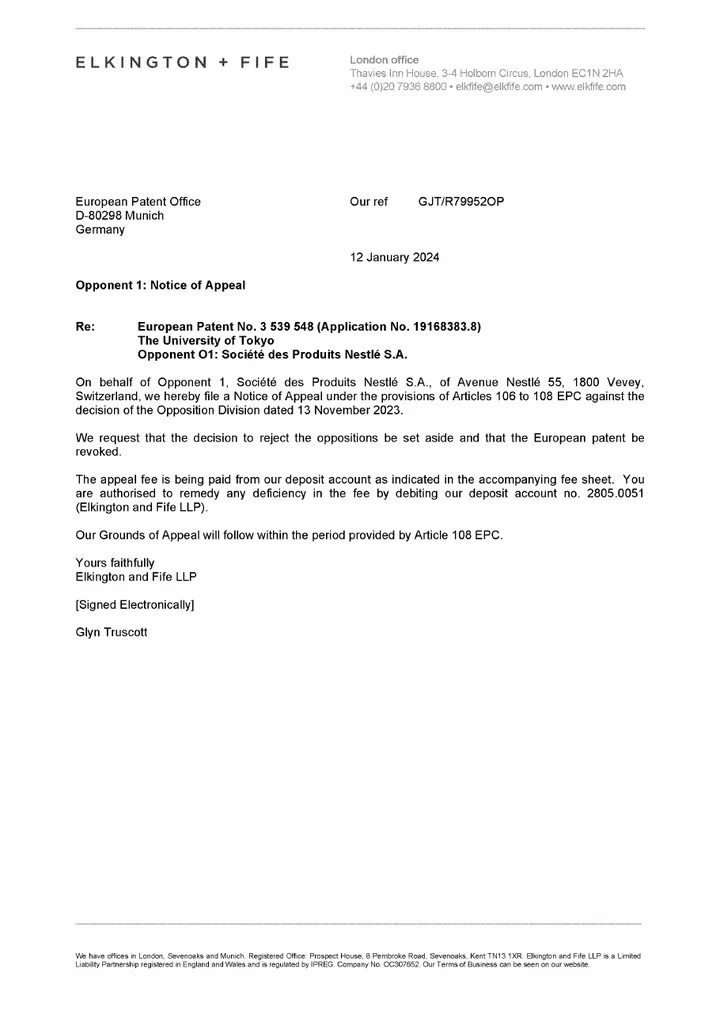
A real one, as filed
Notice of appeal and grounds of appeal against the rejection of the oppositions to EP 3 539 548
Nestlé appealed after the opposition division rejected its opposition to a University of Tokyo patent. The Board set the decision aside and revoked the patent on 10 March 2026.
What it is
Opposition appeal, in brief
An appeal takes an opposition division's decision to a Technical Board of Appeal, the EPO's independent judicial body of last instance. It is the only way to overturn a decision that revoked a European patent, kept it in amended form, or rejected an opposition. The appellant files a short notice of appeal and pays the fee within two months, then sets out its whole case in a statement of grounds within four months.
The Board reviews the decision in a judicial manner rather than rehearing the opposition. It works from the decision, the grounds and the other side's reply, which is due within four months, and it limits new requests, facts, objections and evidence that were not raised before the opposition division (RPBA Art. 12 and 13). Oral proceedings are held on request, in Munich or by videoconference, and the Board's decision is final within the EPO.
Use it when
- The opposition division rejected your opposition, or kept the patent in a form that still covers your product.
- Your patent was revoked or cut back and you want the granted or a broader claim set restored.
- The decision rests on an error you can show from the file: a misread prior art document, a wrong legal test, or a procedural violation such as ignoring a request.
Choose another route when
- The nine-month opposition period is still running and you have not opposed yet: file an opposition first. Notice of opposition
- You were not a party to the opposition but the proprietor has sued you for infringement: join the pending appeal by intervention. Intervention of the assumed infringer
- You only want to put prior art before the Board without becoming a party or paying a fee. Third-party observations
- The decision is already final or you were never an opponent, and you need the patent removed in a court with effect in the UPC states. Revocation action
- The decision is already final and the patent only matters in one or two countries. National revocation of a European patent
Where IPtorch fits
The evidence, checked again before the grounds are due.
The Boards limit new facts and evidence (RPBA Art. 12 and 13), so the appeal is argued mostly on the art already in the case. IPtorch's search charts the claims against it and shows whether closer art exists; your representative drafts the grounds.
- The granted claims split into limitations and charted against the closest art, with the quoted passage behind every cell.
- A ranked list of the strongest documents, to test whether the decision under appeal missed closer art.
- The same evidence for a revocation action at the UPC or in a national court, which the appeal's limits do not bind.
Where these go wrong
What to check before filing.
- Pay the appeal fee inside the two-month period: a notice without the fee is deemed not filed, and the periods under Art. 108 EPC cannot be extended or cured by further processing.
- The statement of grounds must contain your complete case (RPBA Art. 12(3)). Anything not raised and maintained before the opposition division is an amendment the Board may refuse, and changes made after the Board's communication are, in principle, not considered at all (RPBA Art. 12(4)-(6), 13(2)).
- If the decision also hurts you, file your own appeal rather than relying on the other side's: a party that did not appeal cannot continue if the appellant withdraws (G 2/91) and cannot seek more than the decision under appeal gave it (G 9/92).
Start with the evidence.
Upload the patent or enter its number. The invalidity search charts every claim.
Start an invalidity searchFacts checked against the office's rules on 22 September 2026, fees on 13 October 2026. The sample is a public record, reproduced unchanged. IPtorch is not a law firm and this page is not legal advice. Its output is unsigned work product for a registered professional to review, sign and file; nothing is filed and no fee is paid for you. Confirm current requirements, fees and deadlines with the receiving office.