UPCEvidence from your search
Protective letter
Rule 207 RoP; Art. 62 UPCA
A brief lodged at the Unified Patent Court by a company that expects a patent owner to seek a provisional injunction against it. It sets out in advance why any such application should fail; it starts no case, and the owner never has to answer it.
At a glance
- Deadline
- Any time; lasts 6 months
- Official fee
- €300
- Proceeding
- No proceeding · named
- Agent needed
- Yes
- Owner faces
- No response needed
- Who can file
- Any person concerned by a European patent (Art. 47(6) UPCA) who considers it likely that an application for provisional measures will soon be lodged against it at the UPC (Rule 207.1 RoP). Rule 194.6 RoP also refers to protective letters when the owner applies to preserve evidence.
- Deadline
- None: it can be lodged at any time. It stays on the register for six months from receipt and is then removed unless an extension of six months is applied for and paid before the period ends; further extensions are possible on further payment (Rule 207.9 RoP).
- Language
- The language of the patent, meaning the language in which it was granted (Rule 207.2 RoP).
- Anonymous
- No. The letter must name the filer and its representative, the presumed applicant for provisional measures, addresses for service of both, and where available the patent number and any related proceedings, and must state that it is a Protective letter (Rule 207.2(a) to (f) RoP).
- Representation
- Required: the filer acts through a lawyer authorised to practise before a court of a Contracting Member State or a European Patent Attorney with an appropriate qualification such as the European Patent Litigation Certificate (Art. 48(1) and (2) UPCA; Rules 8.1 and 207.2(a) RoP).
- How it is filed
- The representative lodges it electronically in the UPC Case Management System under Protective letters (Rule 4.1 RoP): one patent per letter, the filer's and presumed applicant's details, the letter with any exhibits, and proof that the fee was paid. It is not treated as lodged until the fee is paid (Rules 207.4 and 15.2 RoP).
- Effect
- The Registry records it and alerts all divisions; if an application for provisional measures follows, the panel receives the letter with the application and must in particular consider summoning the parties to an oral hearing (Rules 207.5, 207.8 and 209.2(d) RoP). It starts no proceedings, the owner need not answer it, and the Court can still order measures without hearing the filer (Rule 212 RoP).
- Party status
- None while no application exists. The filer becomes the defendant only if the presumed applicant lodges an application for provisional measures; the applicant then receives a copy of the letter, and until that moment the letter is not publicly available on the register (Rules 207.7 and 207.8 RoP).
Official fee, in detail
| When | Fee |
|---|---|
| Filing a protective letter (Rule 207.4 RoP) | €300 |
| Each six-month extension on the register (Rule 207.9 RoP) | €130 |
| Small or micro enterprise (Rule 370.8 RoP) | 50%: €150 and €65 |
Table of Court Fees as amended on 4 November 2025, applying from 1 January 2026; the fees were €200 and €100 before then. The fee is paid when the letter is lodged, and a small or micro enterprise claims the 50% reduction by affirming its status when filing. Office fees only, checked 13 October 2026.
 3 pages · PDF
A real case, as decided
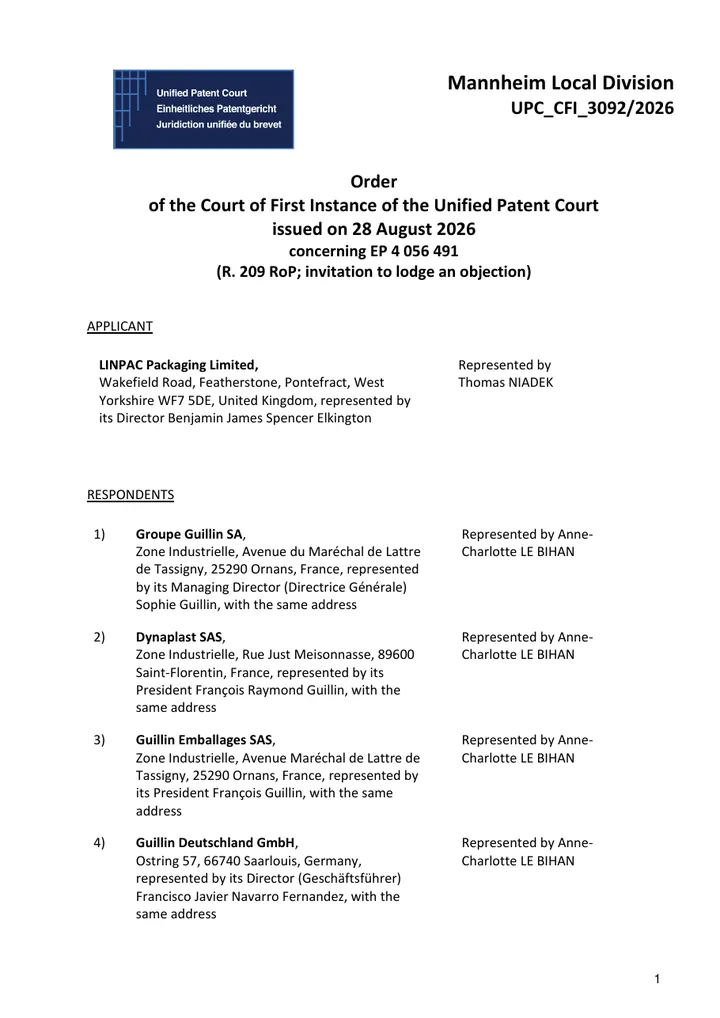
Order after a protective letter: LINPAC v Groupe Guillin
Groupe Guillin lodged a protective letter two days before LINPAC applied for a provisional injunction. The Mannheim local division did not rule without hearing them and invited an objection within six weeks.
What it is
Protective letter, in brief
A protective letter is a pre-emptive brief lodged at the Unified Patent Court by a company that expects a patent owner to seek a provisional injunction or similar urgent order against it. It sets out in advance why any such application should fail, for example because the product does not infringe, the patent is invalid or there is no urgency, together with the supporting evidence.
The letter sits confidentially on the Court's register for six months, renewable for a fee. Nothing happens unless the owner applies for provisional measures; the letter then goes to the judges together with the application and a copy goes to the applicant. Its practical aim is to stop the Court from granting an injunction without hearing the defendant first.
Use it when
- A patent owner has sent a warning letter or threatened an injunction and you expect an urgent application at the UPC.
- You are about to launch a product or exhibit at a trade fair in UPC countries and a competitor's patent is a known risk.
- You have strong non-infringement or invalidity arguments that a judge should see before deciding whether to act without hearing you.
Choose another route when
- You want the patent cancelled, not only a judge briefed in advance. Revocation action
- You want a binding ruling that your product is clear of the patent. Declaration of non-infringement
- The European patent was granted less than nine months ago and you want it narrowed or revoked at the lowest cost. Notice of opposition
- The patent is opted out of the UPC, so an urgent application can only be brought before national courts.
Where IPtorch fits
The validity arguments the judge reads first.
A protective letter answers an injunction before it is sought: non-infringement, invalidity, no urgency. IPtorch's invalidity search builds the invalidity part; your representative lodges the letter.
- Every claim split into limitations and charted against the closest prior art, with the quoted passage behind each cell.
- The strongest documents ranked first, so the letter can lead with its best attack on validity.
- The same evidence carries a revocation action or a counterclaim if the owner sues.
Where these go wrong
What to check before filing.
- The letter drops off the register six months after receipt unless an extension is applied for and paid before that date (Rule 207.9 RoP).
- The Case Management System accepts one patent per protective letter, so a portfolio threat needs several letters and several fees.
- Everything in the letter goes to the patent owner once it applies, and the Court is not bound by it: it may still grant measures without hearing you (Rules 207.8, 209.2(d) and 212 RoP).
Start with the evidence.
Upload the patent or enter its number. The invalidity search charts every claim.
Start an invalidity searchFacts checked against the office's rules on 22 September 2026, fees on 13 October 2026. The decision is a public record, reproduced unchanged. IPtorch is not a law firm and this page is not legal advice. Its output is unsigned work product for a registered professional to review, sign and file; nothing is filed and no fee is paid for you. Confirm current requirements, fees and deadlines with the receiving office.