UPCEvidence from your search
Counterclaim for revocation
CCRArts. 32(1)(e), 33(3) and 65 UPCA; Rules 25 to 32 RoP
How a company sued for infringement at the Unified Patent Court attacks the patent's validity in the same case. It goes into the statement of defence, with every ground, fact and piece of evidence, and a revocation takes effect in every UPC state where the patent is in force.
At a glance
- Deadline
- With the defence, in 3 months
- Official fee
- €14,600 - €26,500
- Proceeding
- Court action · named
- Agent needed
- Yes
- Owner faces
- Validity attacked in its suit
- Who can file
- The defendant in a UPC infringement action who asserts that the patent is invalid (Art. 33(3) UPCA; Rule 25.1 RoP). If the infringement claimant is a licensee, the proprietor is served and becomes a party (Rule 25.2). There is no counterclaim inside a declaration of non-infringement or a revocation action; a DNI claimant later sued for infringement counterclaims in that infringement action (Rule 76 RoP).
- Deadline
- Inside the Statement of defence, due within three months of service of the Statement of claim (Rules 23 and 25.1 RoP). A defence that asserts invalidity must include the counterclaim; it cannot be argued as a mere defence.
- Language
- The language of the infringement proceedings (Art. 49 UPCA; Rule 14 RoP). If the counterclaim is sent to the central division and that language is not the language of grant, the judge-rapporteur may order translations into the language of grant (Rule 39 RoP).
- Anonymous
- No. The counterclaimant is the named defendant, and the counterclaim is directed against the proprietor (Rules 25.1 and 42 RoP).
- Representation
- Mandatory: a lawyer authorised to practise before a court of a Contracting Member State, or a European Patent Attorney with an appropriate qualification such as the European Patent Litigation Certificate (Art. 48(1) and (2) UPCA; Rule 8.1 RoP).
- How it is filed
- With the Statement of defence, lodged electronically in the UPC Case Management System in the infringement case, with the counterclaim box ticked and the counterclaim uploaded in its own category (Rule 4.1 RoP). It must state the extent of revocation sought, the grounds, facts and evidence, and the defendant's position on the Art. 33(3) options (Rule 25.1(a) to (h) RoP).
- Effect
- If it succeeds, the Court revokes the patent in whole or in part, only on the grounds of Art. 138(1) and 139(2) EPC, and to that extent the patent is deemed never to have had effect, in every UPC state where it is in force (Art. 34 and 65 UPCA). The final decision is sent to the EPO and the national patent offices (Art. 65(5) UPCA).
- Party status
- The defendant becomes counterclaimant and the proprietor defendant to the counterclaim, answering within two months with a Defence to the counterclaim and any Application to amend the patent (Rules 29(a) and 30 RoP). The local or regional division may hear both, send the counterclaim to the central division and stay or continue the infringement case, or with the parties' agreement send the whole case there (Art. 33(3) UPCA; Rule 37 RoP).
Official fee, in detail
| When | Fee |
|---|---|
| Infringement action valued up to and including €500,000 | €14,600 |
| Valued up to and including €750,000 | €17,900 |
| Valued up to and including €1,000,000 | €19,900 |
| Valued up to and including €1,500,000 | €25,200 |
| Valued above €1,500,000 | €26,500 (fee limit) |
| Small or micro enterprise (Rule 370.8 RoP) | 50%: €7,300 to 13,250 |
| Appeal on the counterclaim (Rule 228 RoP) | First-instance fee plus 10% |
Table of Court Fees as amended on 4 November 2025, applying from 1 January 2026: the counterclaim costs the same as the infringement action it answers, a fixed €14,600 plus the value-based fee for that action's value, but never more than €26,500. It is paid with the Statement of defence (Rules 26 and 371.1 RoP) and follows the value the judge-rapporteur fixes for the infringement action (Rule 22 RoP). Office fees only, checked 13 October 2026.
 46 pages · PDF
A real case, as decided
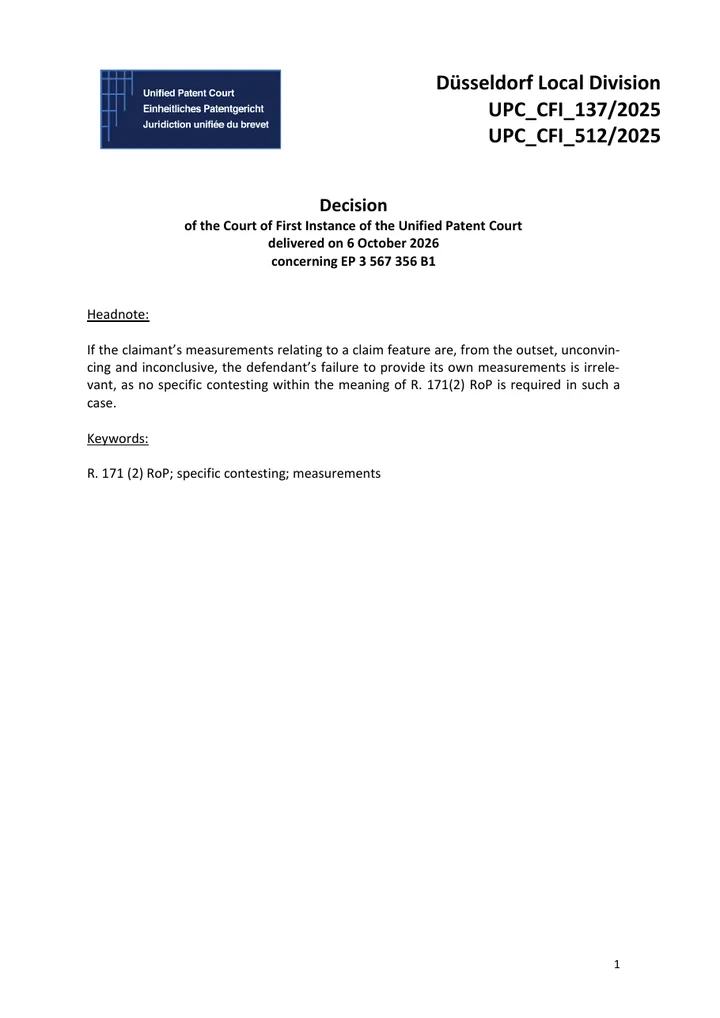
Decision on infringement and the counterclaim for revocation: Inficon v Elitech
Sued over a leak-detector patent, Elitech counterclaimed for revocation. The Düsseldorf local division kept the patent as granted, found no infringement and split the costs.
What it is
Counterclaim for revocation, in brief
A counterclaim for revocation is how a company sued for patent infringement at the Unified Patent Court attacks the validity of the patent in the same case. It is part of the Statement of defence and asks the Court to revoke the patent, in whole or in part, on the grounds of the European Patent Convention such as lack of novelty, lack of inventive step or added matter.
The local or regional division hearing the infringement action normally decides both questions together, with a technically qualified judge on the panel, but it may send the validity question to the central division. The patent owner can answer with amended claims. A revocation ordered on a counterclaim takes effect in every UPC country where the European patent is in force.
Use it when
- You have been sued for infringement at the UPC and believe the patent is invalid.
- You want infringement and validity decided in one set of proceedings, by one panel, in one judgment.
- You want the patent removed for all UPC countries at once rather than country by country.
Choose another route when
- You have not been sued and want to attack the patent first. Revocation action
- You want a ruling that your product is clear of the patent before any infringement action. Declaration of non-infringement
- The European patent was granted less than nine months ago and you want a lower-cost central attack. Notice of opposition
- You were sued in a German national court, for example on an opted-out patent; validity is then attacked at the Federal Patent Court. Nullity action
Where IPtorch fits
The validity case for the statement of defence.
A counterclaim needs the grounds, facts and evidence of a revocation action inside the defence (Rule 25.1 RoP). The builder drafts them as a statement for revocation; your representative carries them into the defence.
- Every claim split into limitations and charted against the closest prior art, with the quoted passage behind each cell.
- At least 50 references read in full and ranked, so the counterclaim leads with its strongest attacks: the UPC expects all of them up front.
- An unsigned statement for revocation from the builder, whose grounds and evidence carry over into the counterclaim.
Where these go wrong
What to check before filing.
- Grounds, facts and evidence belong in the counterclaim lodged with the defence: a late counterclaim or new attack needs the Court's leave, granted only if it could not have been raised earlier with reasonable diligence (Rule 263 RoP).
- Once an infringement action between the same parties on the same patent is pending in a local or regional division, a separate revocation action can only be brought in that same division (Art. 33(4) UPCA), so the counterclaim is the normal route.
- If the fee is not paid or formal defects are not fixed within 14 days of the Registry's invitation, the judge-rapporteur may give a decision by default (Rule 27.2 to 27.4 RoP).
Start with the evidence.
Upload the patent or enter its number. The invalidity search charts every claim.
Start an invalidity searchFacts checked against the office's rules on 22 September 2026, fees on 13 October 2026. The decision is a public record, reproduced unchanged. IPtorch is not a law firm and this page is not legal advice. Its output is unsigned work product for a registered professional to review, sign and file; nothing is filed and no fee is paid for you. Confirm current requirements, fees and deadlines with the receiving office.